


Nothing in life is 100% predictable. Nothing is deterministic, with the possible exceptions of:
- Algebra problems
- Fixed-rule computer programs
- The acceleration rate of a body dropped from a given height on Earth
Yeah, it’s a pretty short list.
And yet, some businesses seem to glide through the chaos of the world with a degree of confidence. Despite the inherent uncertainty of the journey, they seem to know what to do next. Meanwhile, others struggle. Why is that?
Businesses that operate from a strategic framework have a leg up. They are not immune to all of the changes, all of the uncertainty. But they seem to know what’s coming – or could come – in advance.
And, these businesses are able to perform the best consistently.
So what is a framework? Generically, frameworks may go by many names, such as:
- Business operating system
- Diagnostic model
- Decision architecture
- Performance architecture
only to name a few.
What Does Having a Good Framework Do for You?
The world of marketing analytics is full of complexity. Sure, you can keep things simple by only looking at a couple of numbers, like:
- Total sales revenue
Total advertising spend
These are simple, but they lack precision and depth. To actually find out what’s working, what’s not working and what to do next – you need to wade more deeply in the numbers. Your KPIs. But where to start?
You need an organizing principle for your KPIs.
Introducing the JLytics Performance Diagnostic Framework
I created this framework because it’s an excellent starting point – and place to return to – when developing your KPIs.
It’s based on the simple insight that:
Revenue = Number of Customers x Average Lifetime Spend per Customer
Read it again. Yes, it’s really that simple.
So, if you want to increase revenue, mathematically, it’s clear that we would need to increase one or both numbers (“Number of Customers” or “Average Lifetime Spend per Customer” – preferably both).
Structure of the Performance Diagnostic Framework
So what is the framework?
It’s a simple matrix built on two axes:
Conversion: How likely a given segment or persona in the neighborhood is likely to convert to becoming a paying customer
Monetization: The average customer lifetime spend for a given segment or persona
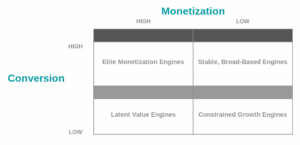
Once you have classified your customers this way, it opens up a world of opportunities.
So You’ve Got Your Segments Classified, Now What?
Once you have organized your customers into this framework, you can make decisions that directly impact your sales.
Why? Because you can make decisions that are best for each persona or segment, essentially fine-tuning your marketing decisions to cater to each one.
Some examples:
- Adjust pricing strategy by persona or segment
- Modify the product and service portfolio composition
- Choose the ideal marketing and advertising channels
- Allocate overall sales and marketing budgets
- Load balance sales or service geographical territories
- Make decisions around your geographical footprint and market entry / exits
- Adjust your brand positioning and messaging
- Train your team to spot upsell and cross-sell opportunities by segment
Of course, to make all of these management decisions also means measuring performance along the same lines.
That means key performance indicators – or KPIs. No longer will it be necessary to wonder which KPIs you should be tracking.
By choosing KPIs that measure progress along all of the above tactical decisions – and by choosing tactical measures based upon the Performance Diagnostic Framework – you now have a cohesive system for managing your marketing system.
Ongoing Measurement
Of course, it’s a never ending process. You will continue to make decisions based upon your framework’s guidance. And you will make adjustments, based on how well you are hitting your KPIs.
It all feeds back to the framework. Instilling confidence in yourself and in your team. Presenting a consistent way of interacting with your customers. Satisfying your CFO, who will want to understand the ROI on your spend. And, most importantly, serving your best customers in the best possible way that caters to their needs.
************
Contact JLytics today to put this framework to work for your business.