


 by Jed C Jones, Founder, JLytics
Large Language Models (LLMs), now more accurately called foundational models, like Claude and ChatGPT have opened up new vistas of possibility for knowledge workers.
Besides using them for the purposes of writing, summarization, text organization and image generation, many knowledge workers rely on LLMs for making decisions. For our purposes here, when I talk about decision-making, I mean it in the sense of choosing the best or most preferable option from a larger universe of options. This can include decisions that take the following shapes:
- Should I do or take action on A, B or C?
- Among A, B and C, which category does this one belong in?
- In which order of priorities should I rank A, B and C options?
Humans have been making decisions since time immemorial. But ever since the rise of descriptive and inferential statistics, we have had access to numbers in order to make reasonable predictions and choosing optimal solutions around our dilemmas.
Herein, I’ll share a very brief history of the decision-making tools I’ve used or built over the years. And, importantly, what I’d recommend for you today.
Simple Sorting and Applying Weighted Averages with Excel
When I started using Excel in 1997, I soon figured out that I could prioritize options by simply assigning a number, 1 through n, to each option, and then sorting them by those priorities. Instant clarity. Felt like magic!
Later, I started introducing a third factor to the mix: a weighting system. So, for each dimension, I would include its subjective score (such as 1 to 10) and a relative decimal-based weight (say, from 0 to 1). That would allow me to calculate the weighted average across dimensions for a given option. Once calculated, I could sort my options by its weighted average score. Again: magic!
I personally relish the feeling of things going from feeling confusing and overwhelming to suddenly being clear and manageable.
This setup in Excel combined subjectivity (i.e., the score assignment, for the most part) with purely deterministic calculations. In this case, deterministic means that it will always be calculated the same way, no matter how many times we try it.
Supervised Machine Learning
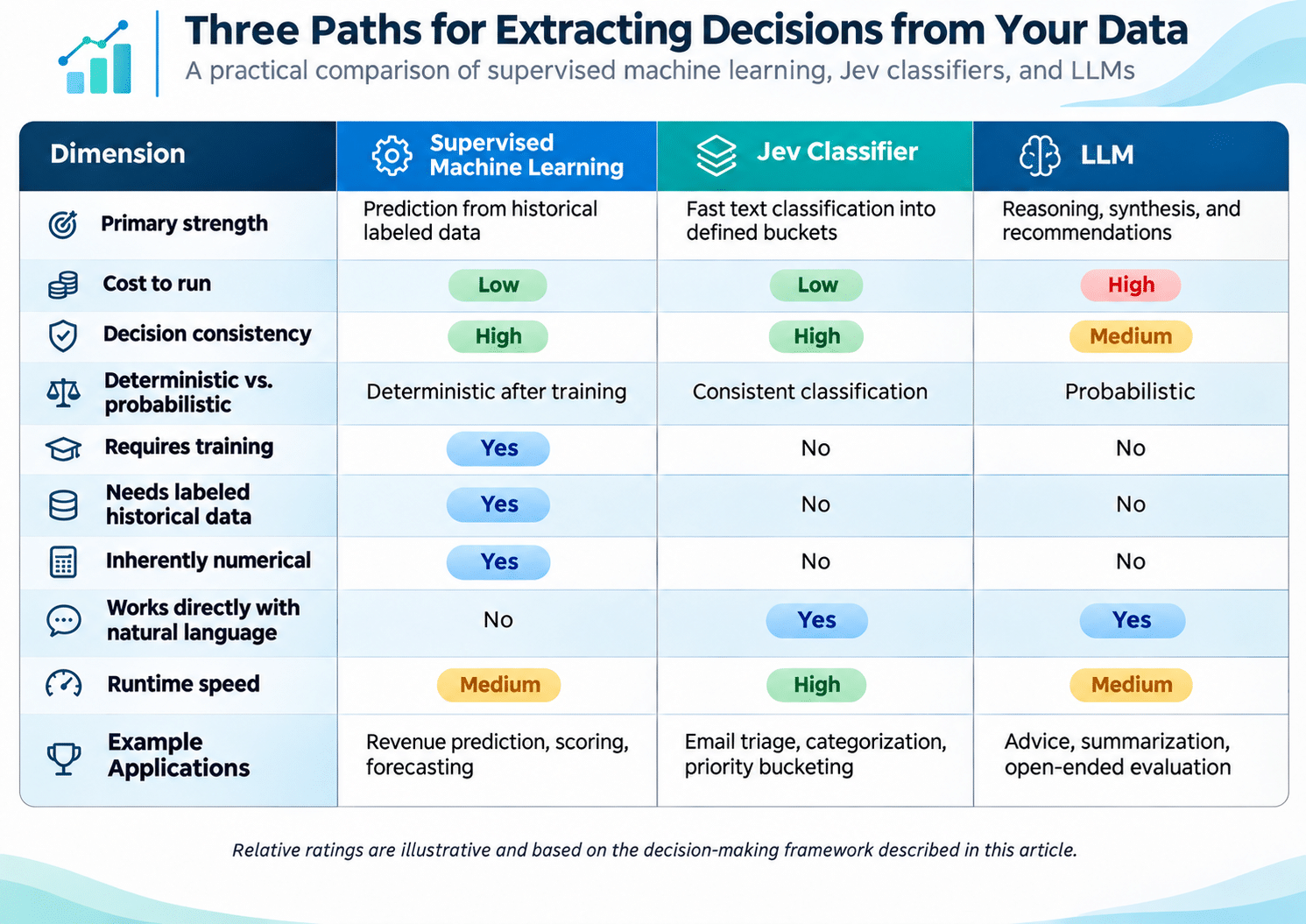
Sometime around 2012, I started experimenting with supervised machine learning to make site selection decisions for clients across multiple industries. I used a piece of software called Neuro Dimension. The power of supervised machine learning is that it can find patterns in various combinations of dimensions that even sophisticated models built on traditional statistics can’t emulate.
As a prime example, I would use this software to crunch dozens of data points (household counts, median age, income and many other factors) around a client’s existing brick and mortar locations. After pulling this data from various databases, I would combine it with a dependent variable, namely: that location’s actual historical revenue. The software would then construct a model, again using weights, that did its best to combine those factors in various ways to produce a set of predicted revenue scores for those historical locations that matched as closely as possible their actual revenue. This could output a continuous value (i.e., predicted revenue) for each location that was very effectively predictive. Once fine-tuned, the model could be used to predict the revenue for a new location under consideration with high accuracy.
In around 2015, I discovered that Python had libraries that carried out machine learning quite efficiently. And, I could easily integrate those scripts into other things I was building, like software or apps.
Machine learning is non-deterministic during the training phase but, once the model has been built and saved for a given application, it produces deterministic results based on new data fed into it. And, apart from the data collection and preparation, supervised machine learning is very low cost to run.
The magical feeling continued.
Enter LLMs
In 2022, LLMs reached the public domain. Besides the most common applications of writing and image generation, millions of us are leaning on them for advice, direction-finding, sorting, evaluation and more. I have done so as well.
LLMs have the advantage of allowing us to avoid rigorous mathematical approaches to decision-making. They rely on math but in a probabilistic sense. At the same time, LLMs are very user-friendly, even to non-mathematical people, because humans can communicate with them simply through the medium of natural language.
There are a few drawbacks to relying solely on LLMs for decision-making, however:
- They can be costly: crunching tens of thousands of words can add up to real money due to the cost of LLMs input and output tokens
- They are probabilistic: give the system the same prompt 3 times and you’ll likely get three different answers
- When you provide them with historical data (see machine learning example), there is no guarantee that they will take into account all of those data points as part of their calculus for the final answer.
Jev, a Newer Development
In September of 2026, TypeSafe AI introduced Jev. This software can read large amounts of text and then produce decisions, or classifications (like A, B or C) very, very quickly and for far more cheaply than LLMs can. You can give Jev just two (or dozens) of possible categories to use. Then, just feed Jev the text and it crunches the numbers with lightning speed. Unlike LLMs, Jev can even give you a confidence score of its classification, so in that sense it’s self-evaluating.
Example: Feed Jev 100 emails and ask it to place each one into one of these four buckets:
- Important and Urgent
- Important, Not Urgent
- Not important and Urgent
- Not important and Not Urgent
Jev will classify each email (in a few milliseconds) by one of each of those categories. No training, no hallucination, no guessing.
Where Does This Leave Us Today?
As a data scientist who builds applications for clients and for my team, I love having more tools for decision-making than ever before. Each of those explored above offers a distinct advantage. None of them is ideal for all situations.
Furthermore, many apps I build and use today combine more than one of these tools. For example, I built an executive coaching app for myself to help manage my advertising agency, Ambient Array, that classifies my recent work, and upcoming schedule, into buckets using Jev. It then creates a summary of its findings and recommendations by leveraging Claude, an LLM. In this case, I get the cost-efficiency and speed of classification with Jev with the natural language-oriented benefits of an LLM.
At the same time, I use supervised machine learning to predict location revenue for new, potential locations for my clients. In this case, neither Jev nor an LLM can outshine the predictive power of a supervised machine learning model.
We live in interesting times. And, when it comes to computer-assisted decision-making, knowing your options makes all the difference.
Contact JLytics today to extract knowledge from your own data for better decision-making.